
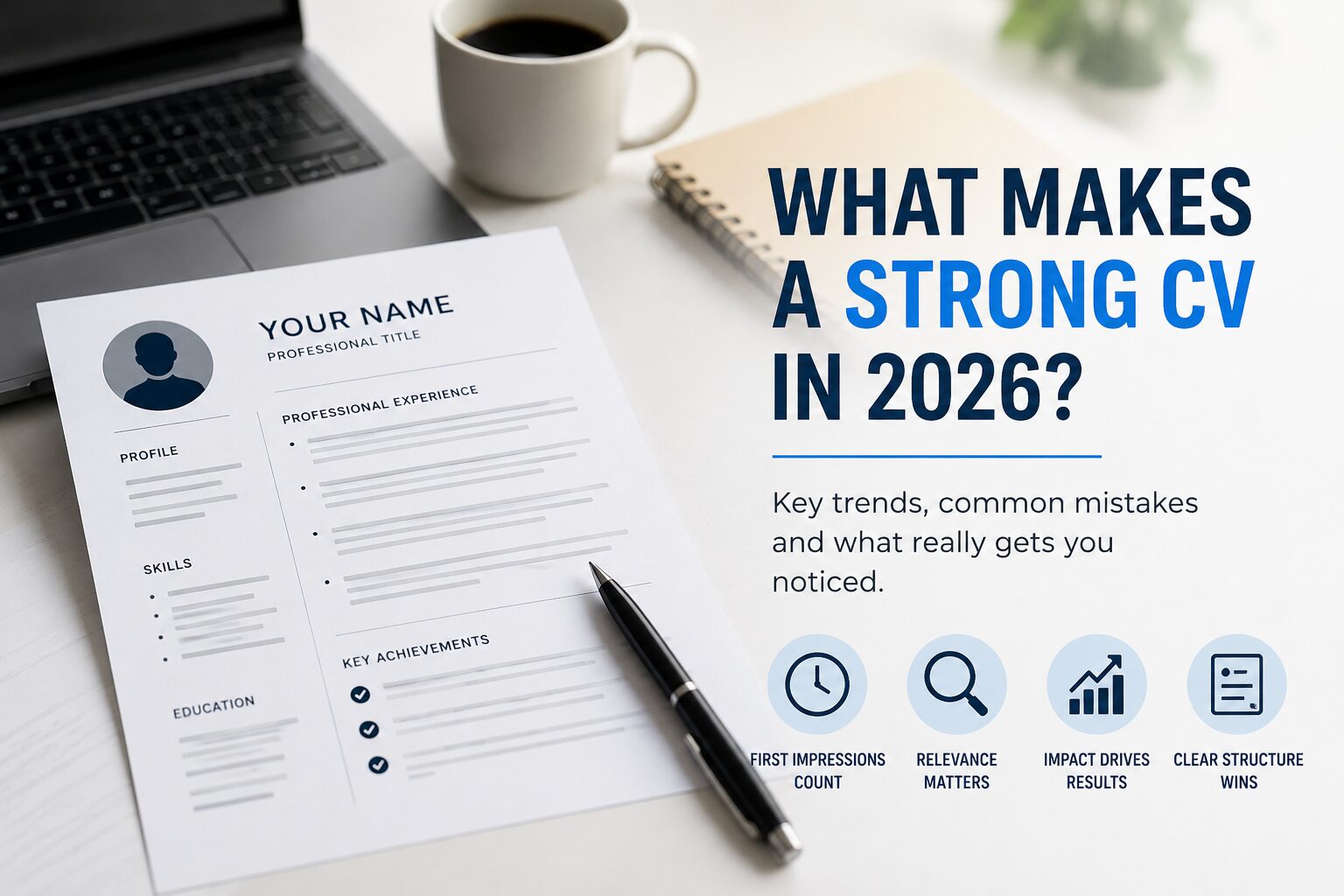
Despite changes in hiring processes, AI screening tools and shifting market expectations, one thing hasn’t changed:
Your CV still decides whether you get seen or skipped.
But what counts as a “strong CV” in 2026 looks different from even a few years ago. It’s no longer just about listing experience—it’s about clarity, relevance and impact in seconds.
Here’s what actually matters right now.
First impressions happen in seconds—not minutes
Most CVs are skimmed in under 10 seconds before a decision is made to keep reading or move on.
That means structure and clarity matter just as much as content.
A strong CV in 2026:
- Is easy to scan quickly
- Has clear role progression
- Highlights impact immediately
- Doesn’t overload information upfront
If someone has to “work” to understand your experience, it’s already a problem.
What instantly gets ignored
Recruiters and hiring managers are seeing more CVs than ever—but certain patterns still lead to quick rejection.
The most common issues include:
- Generic job descriptions
Listing duties instead of achievements makes CV’s blend together instantly. - Overly long CV’s
Two pages is still the sweet spot. Anything beyond that is rarely read in full. - Lack of relevance
Including every job you’ve ever had without tailoring to the role reduces impact. - Weak or missing impact
If there are no results, outcomes or measurable contributions, it becomes hard to differentiate.
What strong CVs do differently
The best CVs don’t just describe experience—they frame it.
They focus on:
- What was done
- How it was done
- What the outcome was
For example:
Instead of saying “Responsible for managing clients”, a stronger version would show:
- client volume
- improvements made
- results delivered
This shift from responsibility to impact is one of the biggest differences in modern CV’s.
Structure is doing more work than ever
With faster screening and digital-first hiring processes, structure has become a decision-making tool.
Strong CVs typically:
- Start with a short, relevant summary
- Put key experience near the top
- Use clean, consistent formatting
- Avoid cluttered design elements
You don’t need a creative CV—you need a readable one.
Keywords still matter—but not in the way people think
With more automated screening in place, CVs still need to align with job descriptions.
However, keyword stuffing doesn’t work.
What does work:
- Naturally using role-relevant terminology
- Reflecting actual skills used in the job
- Matching language without overloading it
The goal is alignment, not repetition.
One CV does not fit every role
One of the most overlooked improvements candidates can make is tailoring.
Strong candidates are increasingly:
- Adjusting summaries per role
- Reordering experience depending on relevance
- Highlighting different achievements for different applications
It’s a small effort that significantly improves outcomes.
Final thought
In 2026, a strong CV isn’t about how much you include—it’s about how quickly someone understands your value.
The best CVs don’t try to say everything.
They focus on saying the right things clearly, quickly and with impact.